
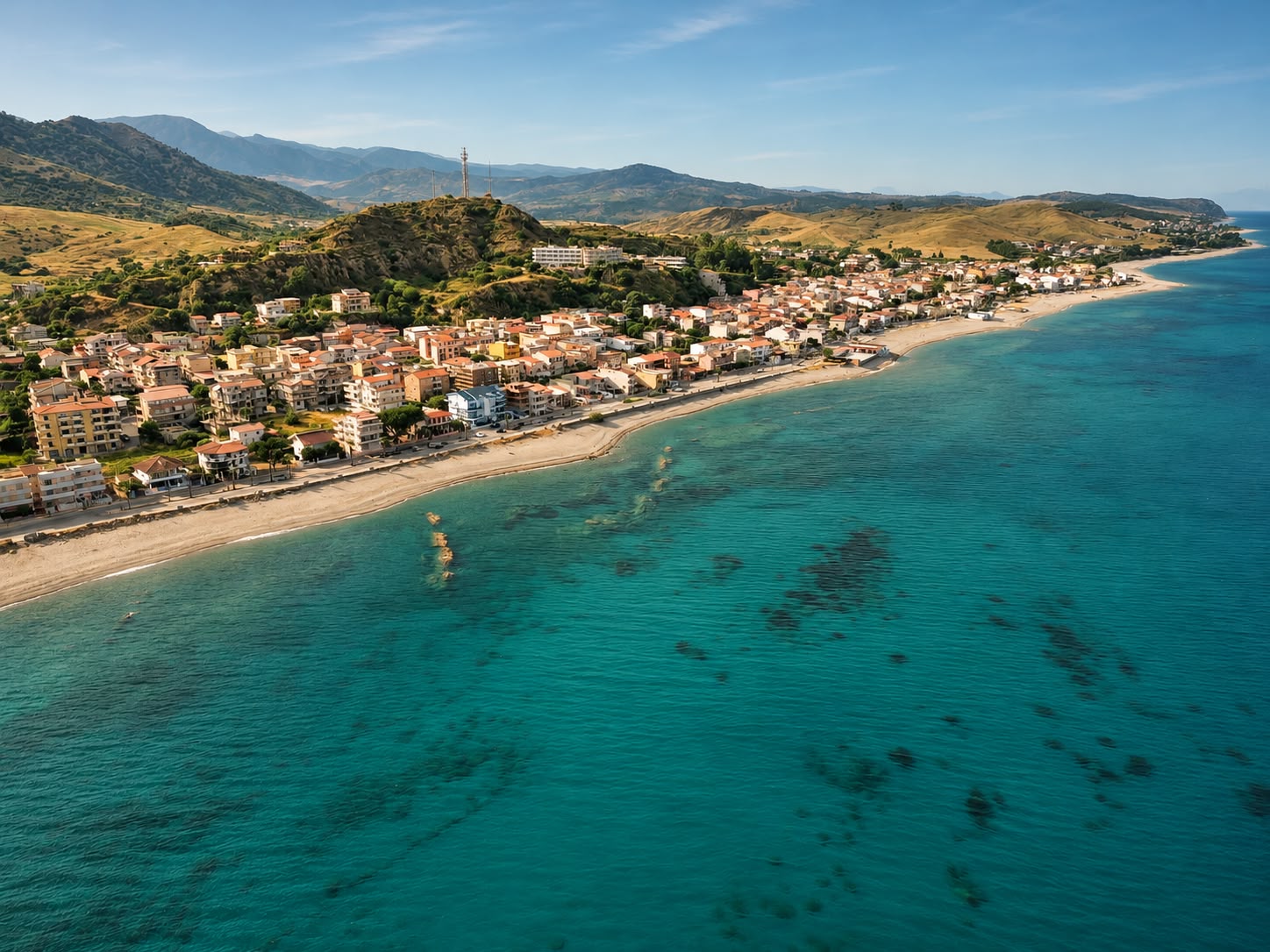
Brancaleone is a municipality in the Ionian region of Calabria, in the province of Reggio Calabria, overlooking one of the stretches of sea along the Gelsomini coast.
Its territory stretches along the beach for about 10 kilometres and rises up towards hills covered with olive groves, vineyards and bergamot orchards.
Brancaleone is a place of great interest for nature lovers, as during the summer months it is the scene of an event that never fails to amaze year after year: the hatching of the Caretta caretta turtle eggs and the hatchlings’ race towards the sea – a truly thrilling spectacle.
But there’s more: in Brancaleone, you can visit the places where the writer and poet Cesare Pavese spent his time in exile and go on an excursion to explore the Brancaleone Vetus archaeological park.
And, of course, how could we fail to mention the unspoilt beach at Galati, a hamlet of Brancaleone, from where you can enjoy the beauty of the Ionian Sea and the sunsets over the Strait of Messina.
In short, if you’re thinking of planning a trip to Brancaleone, this guide is just what you need: here you’ll find all the useful information on what to see, how to get there and where to stay.
Brancaleone in a nutshell
- Where is it: the province of Reggio Calabria, on the Ionian coast, along the Costa dei Gelsomini.
- The sea: extensive stretches of public beach and waters protected by the Costa dei Gelsomini Regional Marine Park.
- Turtles: It is known as ‘the city of turtles’, due to the nesting grounds of the loggerhead sea turtle (Caretta caretta) and its Sea Turtle Rehabilitation Centre.
- The story: the ancient village of Brancaleone Vetus, now an Urban Archaeological Park, and the place where Cesare Pavese was placed under house arrest.
- Local produce: bergamot and almond.
How to get to Brancaleone
- By car: Take the Strada Statale 106 Jonica, which passes through Brancaleone Marina. The village is about 60 kilometres from Reggio Calabria and 30 from Locri.
- By train: Brancaleone has a station on the Ionian railway line, right in the town centre and just a short walk from the sea.
- By plane: The nearest airport is Tito Minniti Airport in Reggio Calabria. From there, you can continue your journey by car or train.
Where is Brancaleone?
Brancaleone is situated on the Ionian coast of the province of Reggio Calabria, at the southernmost tip of the peninsula.
Its territory stretches from the area around Capo Spartivento to the border with Bruzzano Zeffirio, at a point where the Locride region meets the Grecanica area.
The village is spread over two levels. Down below, along the coast, lies Brancaleone Marina, where most of the village’s inhabitants now live.
About 3 kilometres from the coast, on a sandstone hill, lies the ancient settlement of Brancaleone Vetus, from where the view stretches across the entire coastline.
Behind the village lies the so-called ‘Valley of the Armenians’, which takes its name from the communities that arrived from the East during the Byzantine era and which have left traces that are still visible in the old town.
A bit of history
Brancaleone’s first name was Sperlinga, or Sperlonga, linked to the word ‘grotta’.
It is no coincidence that the earliest evidence of permanent settlement on the hill dates back to the monks who arrived from the East during the Byzantine period, and who carved their cells and places of worship out of the rock.
In the Middle Ages, the village was fortified around a castle, which in the 14th century belonged to the Ruffo family, and took the name Motta Leonis, from which its current name is said to derive.
In the centuries that followed, it passed from one feudal family to another, until it came into the hands of the Carafa family, who held it until the early nineteenth century.
The turning point came with the earthquakes. Dopo quello del 1783 alcune famiglie scesero verso il mare, dove nacque l’attuale Brancaleone Marina, che divenne anche sede del Comune. Earthquakes in the early 20th century and a severe flood in the 1950s prompted the last remaining inhabitants to leave the hill.
Since then, the old village has remained uninhabited, whilst life in the town has shifted entirely to the coast.
Discovering Brancaleone Marina
The sea and the beach
Brancaleone beach, also known as ‘the turtle beach’, is home to a very delicate ecosystem that is vital for the conservation of the loggerhead sea turtles (Caretta caretta), which lay their eggs along the stretch of coastline between Palizzi and Bruzzano Zeffirio – a stretch that also includes Brancaleone Marina.
Every year, between August and October, the beach becomes home to turtle nests, and this event attracts many enthusiasts who come to Brancaleone to watch the eggs hatch.
If you happen to witness this event, it is important to take care not to get too close; watch from a distance without touching or moving the hatchlings, as they must reach the sea on their own.
Brancaleone Marina offers long stretches of unspoilt, public beach, ideal for those who prefer to enjoy a seaside holiday in complete freedom.
But there’s more: these beaches form part of the Costa dei Gelsomini Regional Marine Park, the protected area that stretches from Capo Bruzzano to Punta Spropoli.
The seafront runs alongside the beach for much of the town and is home to numerous bars and restaurants which, especially in summer, offer good food with sea views and plenty of entertainment.
The Sea Turtle Rehabilitation Centre
One of Brancaleone Marina’s most iconic landmarks is the Sea Turtle Rehabilitation Centre, which is housed in the former railway station ticket office and is run by the non-profit organisation ‘Blue Conservancy’.
It is, in every sense, a hospital for sea turtles, where injured turtles – mainly those harmed by fishing nets, plastic and boat traffic – found in the waters between Sicily and Calabria are given care and treatment.
The turtles are rescued and rehabilitated before being released back into the wild.
You can visit the centre accompanied by some volunteers and get a close-up look at the animals in their care. A visit to the centre is an educational and moving experience suitable for adults and children alike, and is aimed, above all, at raising visitors’ awareness of the environmental issues affecting this species and others.
During the summer, the centre also organises a summer camp, a project aimed at promoting eco-sustainable tourism by involving participants in activities to protect and care for turtles.
If you’d also like to enjoy these unforgettable experiences, we recommend checking the latest opening times and details on the the Centre’s official website.
The Maritime Museum
Just a short walk from the town hall, the Museo del Mare explores the connection between Brancaleone and the sea.
The museum, run by the Caretta Calabria Conservation association, offers visitors the chance to immerse themselves in the local maritime culture and discover the biodiversity of these areas.
It comprises three main areas, each dedicated to a specific theme:
- The first area features models of a number of historic vessels, allowing visitors to retrace, via a virtual tour, the evolution of navigation over time;
- The second area features various pieces of small-scale fishing equipment donated by local fishermen;
- In the third area, on the other hand, there are scale models of cetaceans and scenes depicting the life cycle of the loggerhead turtle (Caretta caretta).
For more information on how to book a visit to the museum, please take a look at the the association’s website.
Cesare Pavese’s House of Exile
Brancaleone is not just about the sea and nature; it is also a ‘literary place’.
In the 1930s, the village was home to one of the greatest Italian writers of the century, Cesare Pavese.
His enforced stay on the shores of the Ionian Sea left a deep mark both on his works and in the memory of the town, which still preserves the sites associated with him to this day.
Il 4 agosto 1935 Cesare Pavese scese dal treno alla stazione di Brancaleone. Era stato condannato dal regime fascista a tre anni di confino per antifascismo, una pena poi ridotta, e rimase in paese fino a marzo 1936.
After spending a few days in a hotel, he settled into a small room on the main street, with a window overlooking the sea.
To make ends meet, he gave Latin lessons to the local children, who called him ‘U prufissuri’.
It was here that he began writing his diary The Art of Living and gathered the experiences he would go on to recount in the novel Prison.
In una lettera alla sorella Maria del 27 dicembre 1935 scriveva: “The people of these villages display such tact and courtesy that there can be only one explanation: civilisation here was once Greek.”
Today, that room has been turned into a house-museum, where the bed, the desk and the carbide lamp have been arranged just as they were back then, precisely to transport visitors into the writer’s world during his stay in Brancaleone.
The route through Pavesi’s haunts begins at the House of Exile, taking in the places that were part of the writer’s daily life: the barracks where he went to sign in every day, the café where he read the newspaper, the rock by the sea where he loved to sit, and the staircase inscribed with his verses.
Visits to the Dimora and the Pavesian trail are by booking only, with guided tours organised by the Brancaleone Pro Loco.
The Altalia Waterfalls and the Devil’s Gorges
A few kilometres from the town centre flows the Altalia, one of the streams that run down towards Brancaleone Marina, formerly known as the Ziglia.
The Altalia river rises on the Campolico plateau and, before reaching the sea, cuts through the hills below Brancaleone Vetus, forming a series of narrow gorges known locally as the Gole del Diavolo.
Their name stems from an ancient legend, which tells of three local men who went there to read a forbidden book.
Because of their curiosity, the three men fell victim to a strange occurrence: the sky turned black, a fierce wind blew up and, when it was all over, the three were found in three different villages, able to speak only unknown languages.
The walk along the stream is of medium-easy difficulty and offers stunning views, amongst the ruins of ancient water mills and the Saracen fortress of Capistrello, stone terraces and centuries-old olive trees.
Along the stream there are also three waterfalls, 10, 18 and 28 metres high, equipped for sport abseiling; suitable only for those who practise canyoning.
The best time to do this is between November and May, when the stream has the most water.
The Brancaleone Vetus Urban Archaeological Park
Heading inland from the marina, after about 3 kilometres you reach Brancaleone Vetus, the village’s ancient quarter.
Brancaleone Vetus stands on a sandstone hill at an altitude of around 310 metres and is one of the most evocative ‘ghost towns’ in the province of Reggio Calabria.
Here, history can be read directly from the rock. The monks who arrived from the East carved their cells and a number of small rock-hewn churches out of the sandstone; these still bear Armenian engravings to this day.
There are around ten monastic cells and four cave churches in the village. The most famous is the Cave of the Tree of Life, a church carved out of the rock with a central pillar, on whose walls a cross and a stylised peacock can still be seen – symbols that reflect the traditions of Armenia and Cappadocia.
As you stroll amongst the ruins, you will also come across the Grotta della Madonna del Riposo, with its frescoes, the ancient silos hewn into the ground and the remains of the churches that once brought the village to life.
From the top of the hill, the view stretches across the entire coastline, from Capo Bruzzano to the Capo Spartivento lighthouse, offering one of the best vantage points from which to admire the sunset over the Ionian Sea.
Dal 2008 il borgo è riconosciuto come Parco Archeologico Urbano.
Credit for its revival is due above all to the Pro Loco of Brancaleone and its chairman, Carmine Verduci, who in recent years have helped to enhance and maintain the area, thanks also to the active involvement of the local residents.
The hamlet of Galati
Heading towards Capo Spartivento, you come to Galati, a hamlet of Brancaleone.
Galati is certainly a quieter and more secluded area than the more populous and lively Brancaleone Marina.
Galati beach is unspoilt and open to the public, with fine sand interspersed with a few patches of gravel.
The water is shallow and slopes gently, making this stretch of coastline the ideal spot for families with children and for those who enjoy snorkelling.
Here too, every year, loggerhead turtles (Caretta caretta) lay their eggs.
The landscape of Galati is framed by badlands – clay hills shaped by the wind and rain – which give this stretch of coastline an almost lunar appearance.
They are smaller than the Calanchi Bianchi di Palizzi, which we told you about in our Guide to Palizzi, but just as evocative.
A visit to the Brancaleone badlands is free of charge and does not require a booking.
Set in a panoramic location, amongst vineyards and olive groves, lie the ruins of the Torre di Galati, a 16th-century tower built to keep watch over the coast.
It can be reached via a short walk, which offers breathtaking views of the valley and the sea.
Brancaleone’s bergamot and almond
Brancaleone is also characterised by its unmistakable flavours and aromas.
The most characteristic example is the bergamot, a citrus fruit that grows almost exclusively in a narrow strip along the Reggio Calabria coast, and the Brancaleone area is one of the prime locations for its cultivation.
Bergamot from Reggio Calabria is famous throughout the world, above all for its essential oil, which is extracted from the peel and used by the leading perfume houses (it is one of the traditional ingredients of Eau de Cologne).
But it also plays a key role in the kitchen, in the production of desserts, liqueurs and creams that are enjoyed all over the world.
There are several organisations in the area that grow and process bergamot, helping to promote this unique product and contribute to the region’s growth.
Some of these companies welcome visitors with tasting tours, whilst also offering the chance to stroll amongst the bergamot trees and discover the various stages of the production process, from harvesting to the finished product.
Another speciality of the Brancaleone area is its almond paste-based products.
For decades, the village has been upholding a tradition of craftsmanship that began in the late 1960s in a small family workshop, which has grown over time into a well-established business, whilst never losing its connection to the local area.
The production process still follows the traditional method. The almonds are crushed, mixed with water and sugar, and then slowly ground using granite rollers to preserve their flavour and properties.
The result is a wholesome almond paste, made with just a few ingredients and containing no preservatives or added flavourings.
Almond paste is used to make fresh, delicate almond milk and a range of specialities for patisseries and ice-cream parlours.
There is no shortage of combinations featuring bergamot, such as spreads that bring together, in a single bite, the two flavours that symbolise this stretch of the Ionian coast.
Tours and experiences: who to contact
Much of what there is to experience in Brancaleone today is down to the work of the Pro Loco and its young chairman, Carmine Verduci.
It is thanks to their voluntary efforts that Brancaleone has, in recent years, been rediscovered and given the recognition it deserves.
Events, exhibitions and experiences in the area have turned the spotlight on this precious corner of Calabria, showcasing its potential and enabling everyone to appreciate its history and culture.
To find out more about the experiences on offer in Brancaleone, please visit their website prolocobrancaleone.it.
Where to stay in Brancaleone
To make the most of your stay and discover the charming spots in Brancaleone, we recommend staying here for a few days so that you can take your time to appreciate every corner of the town.
The Branca Affitti Brevi network offers a range of options for a comfortable and unforgettable stay.
Galati
Contrada San Giorgio
Brancaleone Marina
Would you like some advice on which accommodation to choose for your stay? Get in touch and we’ll help you find the option that best suits your needs.
FAQ
What is there to see in Brancaleone? The main attractions are the beach and the seafront promenade, the Sea Turtle Rescue Centre, the Maritime Museum, Cesare Pavese’s house where he was placed under house arrest, the Brancaleone Vetus Archaeological Park, the Altalia Waterfalls and, in the hamlet of Galati, the beach, the badlands and the Tower of Galati.
How do you visit Brancaleone Vetus? You can explore the old village on guided tours organised by the Brancaleone Pro Loco, which must be booked in advance.
Can you see Caretta caretta turtles in Brancaleone? Yes, between August and October, the turtles nest on the beaches of Brancaleone and Galati, and you can get up close to them on a guided tour of the Sea Turtle Rehabilitation Centre.
Where can you find out about how bergamot is processed? In Brancaleone, there are businesses that specialise in bergamot and welcome visitors for a tour of the gardens and production facilities, often including a tasting session.